Riveting Tools
The rivet (or rivets) is used to permanently join components together.
The right tool is required for this.
In addition to classic rivet head makers, rivet pullers, and rivet setters, you will also find special tools here, such as a rivet base or rivet iron for making your own rivets.
You can find out how to rivet correctly and other useful information about rivets further down on this page.


DIN 660, Steel RSt 36-2 Shank diameter #Varinfo shank length Some projects require only a few rivets, and not everyone has enough workshop space to keep a whole pack on the shelf for that "just-in-case" scenario... That is why we are now selling round-head rivets individually. Sizes not listed here are currently not available for individual sale. Note on the designation: The first number indicates the shank diameter, the second the shank length (excluding the head height!). For example, a rivet DIN 660 - 5 x 10 has a shank diameter of 5 mm and a shank length of 10 mm. The total length of the rivet in this case is 13 mm.


Note on the designation: The first number indicates the shank diameter, the second the shank length (excluding the head height!). For example, a rivet DIN 660 - 5 x 10 has a shank diameter of 5 mm and a shank length of 10 mm. The total length of the rivet in this case is 13 mm.


Various shapes and sizes Half-round rivets DIN 660 Countersunk rivets DIN 661 Half-round rivets DIN 660: Ø 2-6 mm Length 2-30 mm Countersunk rivets DIN 661: Ø 3-4 mm Length 6-30 mm Package purchase

Various shapes and sizes Half-round rivets DIN 660 Countersunk rivets DIN 661 Half-round rivets DIN 660: Ø 2-8 mm Length 3-50 mm Countersunk rivets DIN 661: Ø 2-8 mm Length 4-60 mm Package purchase

Various shapes and sizes Half-round rivets DIN 660 Countersunk rivets DIN 661 Half-round rivets DIN 660: Ø 1-10 mm Length 4-55 mm Countersunk rivets DIN 661: Ø 2-8 mm Length 4-60 mm Sold in packs

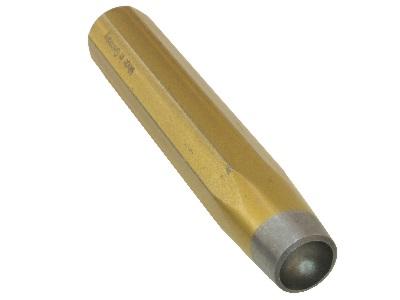
octagon, Chrome-Vanadium, DIN 6435 Set of 7 pieces, consisting of rivet header 2,3,4,5,6,8,10 mm The rivet head makers in a set, in a practical plastic box made from 100% recycled plastic. The rivet head makers in a set, in a practical plastic box made from 100% recycled plastic. Octagonal shaft Burned-enamel finish Chrome-vanadium air-hardening steel Selectively hardened Hammer head tempered Curving, beading, and chipping are virtually eliminated thanks to the selective hardening process The classic - MADE in Germany!


for rivets with a shaft diameter of 2-20 mm, made of hardened tool steel, approx. 100x100x20 mm The rivet base makes riveting easier and the shape of the rivet head is retained even with strong blows. made of hardened tool steel safe and stable support plate quick and easy riveting counter borehole for quick attachment in the square hole of the anvil, on the workbench or in a leg vice flexible to use suitable for rivets with shank diameter: 2, 3, 4, 5, 6, 8 mm (DIN 660) and 10, 12, 16, 20 mm (DIN 124)

with handle Caution: When the rivet head is knocked off, it jumps off at high speed and "flies" away. Nobody is therefore allowed to be in the danger area or a safety guard must be used !


made in Germany drop forged from C35 steel very robust design good handling painted black (rust protection) Indicated is the cross section which the tong encloses perfect. The tong covers a small range below and above the indicated cross section.


Lightweight and durable design Forged from 50CrMo4 Blued finish - no paint burning Ergonomic design Perfect handling Lightweight shape Well-thought-out jaw shape for secure workpiece grip Tom Clark (1932-2008) is the namesake of our series of superbly crafted blacksmith's tongs. They were developed from the suggestions of experienced blacksmiths, taking ergonomic insights into account and combining them with modern materials and manufacturing techniques. The tongs are lighter yet more durable than conventional tongs. They are made of high-quality heat-treated steel (50CrMo4) and are therefore perfectly suited to the conditions in a blacksmith's shop.


Forged from tool steel, approx. 420 x 40 x 40 mm (LxWxH), Round holes 4, 5, 6, 8, 10,12, 14 mm, chamfered on one side, hardened and tempered Ideal for producing rivets in smaller batches. This tool allows you to produce various rivet sizes and lengths cleanly and accurately. It can also be used to produce ball studs. Features: forged of tool steel Hardened and tempered Precisely machined holes No jamming of rivets Always cool the tool thoroughly during use and do not allow it to overheat. These special tools are forged in the Reisinger forge in the heart of the lower Mühlviertel in Austria according to the highest quality standards. ...and if you want to learn more about Peter Reisinger and his family business, you can find more information in the "Manufacturer" tab.

octagon, Chrome-Vanadium, DIN 6434 Set of 7 pieces, consisting of rivetting setter 2,3,4,5,6,8,10 mm The rivet head makers in a set, in a practical plastic box made from 100% recycled plastic. Octagonal shaft Burned-enamel finish Chrome-vanadium air-hardening steel Selectively hardened Hammer head tempered Curving, beading, and chipping are virtually eliminated thanks to the selective hardening process The classic - MADE in Germany!


for fixing the guillotine, riveting plate or other tools in the square hole of the anvil, Square 25 x 25 mm, length approx. 60 mm, incl. M10 cylinder head screw
The riveting process
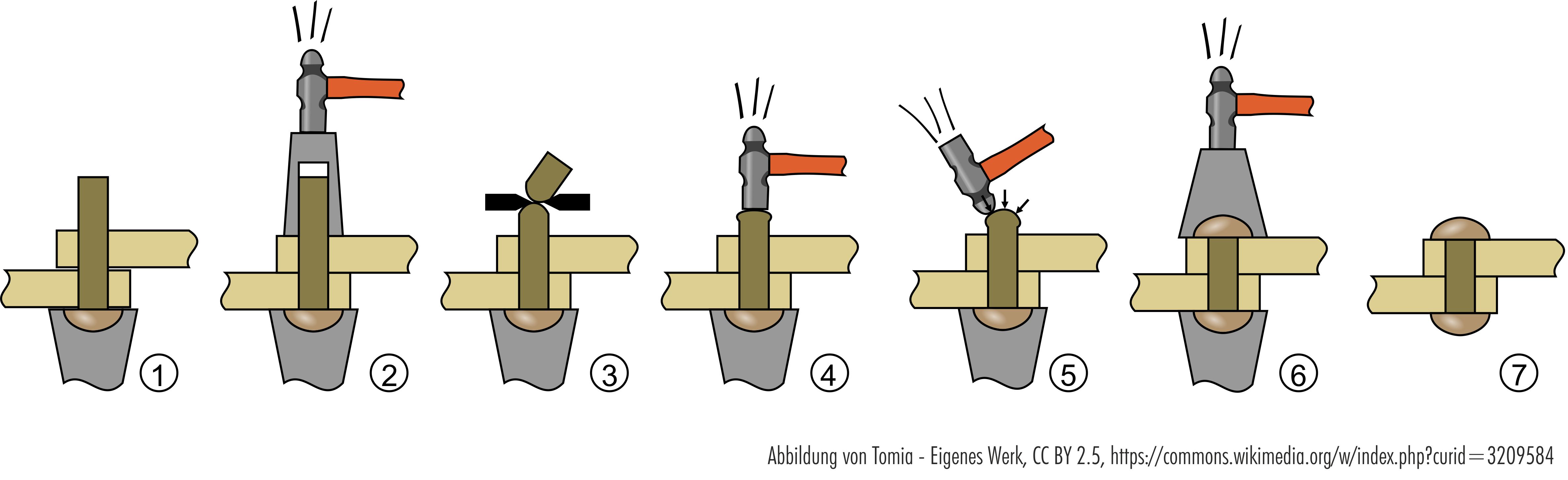
- Insert the rivet into the holes and place it on a counterholder or base.
- Press the material flat against each other using the rivet puller.
- Shorten (if the correct length could not be selected, see below).
- Upset the rivet shank.
- Pre-form the rivet head using circular blows with the ball-head hammer.
- Finally form the rivet head using the head maker.
- Done!
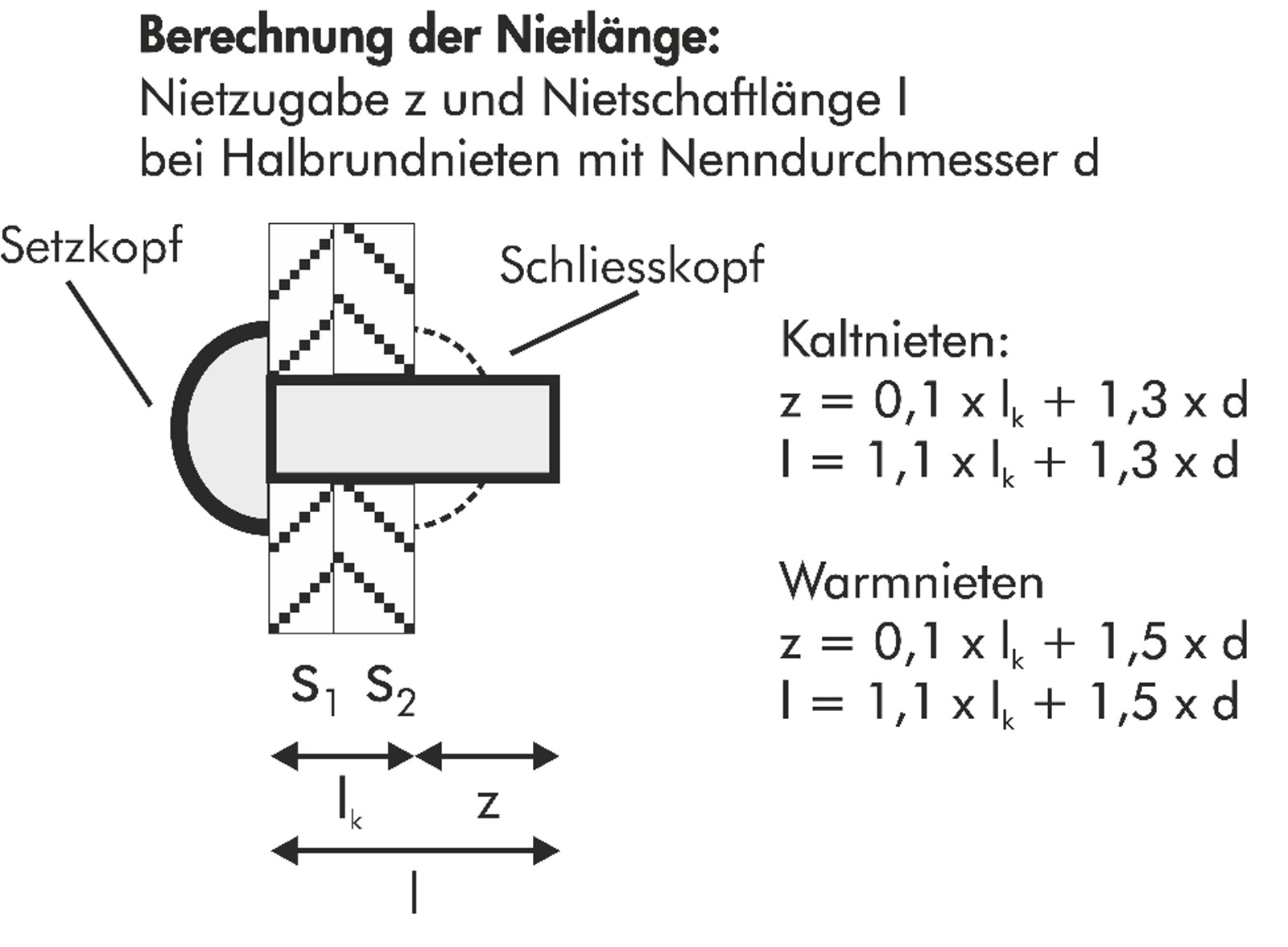
Calculating Rivet Length
The required total length can be calculated based on the thickness of the components to be joined and the shank thickness used. It also depends on whether cold or hot riveting is used.
Normally, only "small" rivets are cold riveted; from a shank diameter of 8-10 mm, hot riveting is recommended. Of course, larger rivets can also be deformed using brute force.
In principle, however, there is also a static/technical difference in the connection. With hot riveting, the rivet contracts again as it cools, pressing the components firmly together (positive connection). With cold riveting, this contraction is missing; only a "positive" connection is created.
Making a riveted joint
The film shows in detail the individual steps involved in making a riveted joint.
It also shows common mistakes when making riveted joints.
Questions - Answers - FAQ
Many questions about the topic of Rivets, to which we try to give answers and without meaningless AI texts.
Do you still have questions? Then please ask us directly here:
E-mail:
Buy riveting tools?
From us, you can buy rivet head makers, rivet setters, rivet irons, and all kinds of riveting tools in the highest quality.
Our riveting tools are specially hardened and tempered, ensuring a long service life and safe use.
What should you look for when buying?
Here, it's important to use the correct material for the actual tool. It should be tough and hard, but not brittle.
Hardening is also crucial. Some tools should be selectively hardened to ensure safe use.
What is a rivet?
Everyone knows the rivets you see at fairs, but this has nothing to do with them.
A rivet is a cylindrical fastener that, through plastic deformation, creates an indetachable connection between flat material pieces lying on top of each other, such as sheet metal, plastics, leather, or textiles. This process is called riveting.
What are rivets designated?
Note on the designation: The first number indicates the shaft diameter, the second the shaft length (excluding the head height!).
Accordingly, for example, a rivet DIN 660 - 5 x 10 has a shaft diameter of 5 mm and a shaft length of 10 mm.
The total length of the rivet in this case is 13 mm.
Making rivets?
Can I make rivets myself?
YES
We have the right tools for this in our range.
You can find the riveting iron here:
Custom rivet - right size?
Can't find the right size?
We can produce all possible sizes for you.
Of course, this is usually only worthwhile for larger quantities.
Just ask us.
What material are rivets made of?
Rivets are made of various materials.
Rivets are made of:
- Steel
- Aluminum
- Brass
- Copper
- Plastic
Steel rivets are mainly used in forging.
Cold or Hot Riveting?
Normally, only small rivets are cold riveted; from a shank diameter of 8-10 mm, hot riveting is recommended. Of course, larger rivets can also be deformed using brute force.
Hot Riveting = Frictional Connection
With hot riveting, the rivet contracts again as it cools and presses the components firmly together (frictional connection).
Cold Riveting = Positive Connection
With cold riveting, the rivet does not "contract," and only a "positive" connection is created.
Is there a standard (DIN) for rivets?
Of course, there is a standard here too (DIN/ISO/...)
Half-round rivets up to Ø 8 mm = DIN 660
Half-round rivets from Ø 8 mm = DIN 124
Countersunk rivets = DIN 661
The Rivet(s)? (m/f/d)
Or what is the correct term?
The or the rivet (plural rivets) in technical terms
or rivets (plural rivets)
Excerpt from https://de.wikipedia.org/wiki/Niet, accessed on March 26, 2025