
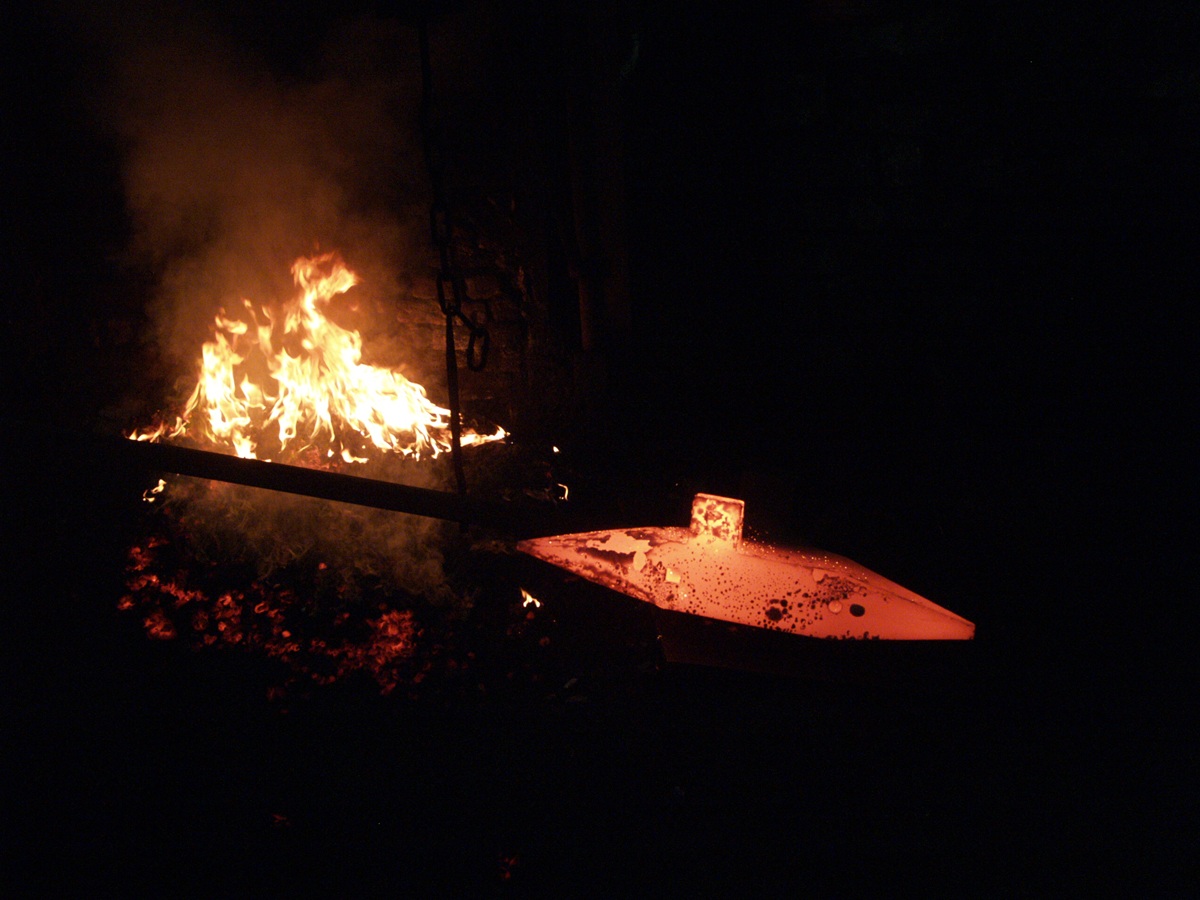
Anvil
The anvil is one of the most important tools in the forge.
In the past, the large anvils consisted of several parts that were welded together in the fire. A steel plate was then welded on to create a high-quality and hardenable track. Finally, the track was hardened.
Today, most anvils are made of alloyed cast steel, which is laboriously hardened in the track area - this achieves just as good a quality as the old anvils.
A wide variety of anvil shapes have developed in different regions, with certain shapes having advantages and disadvantages depending on the activity. For example, the heavy, slim anvils with the tapered horns are suitable for artistic forging of large objects. A knife maker, on the other hand, is more likely to work with a 50 or 80 kg anvil with a wide track.
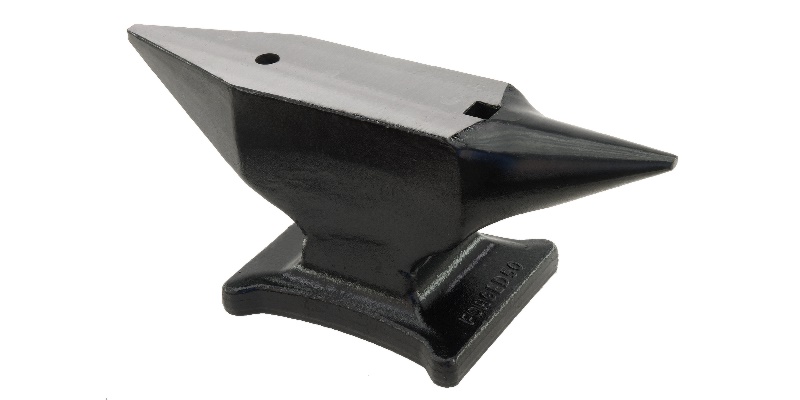
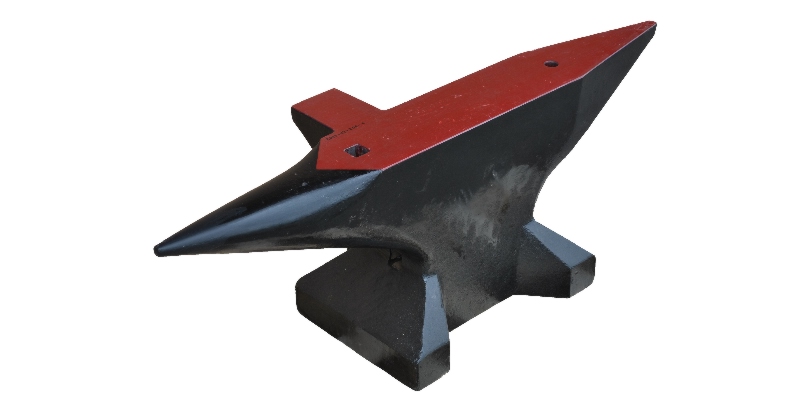
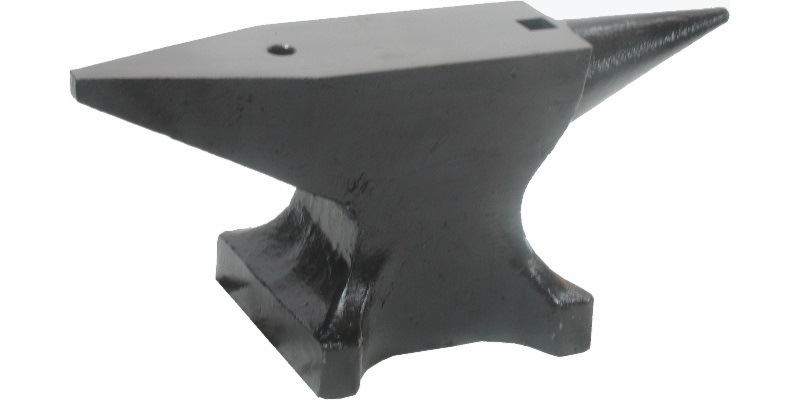
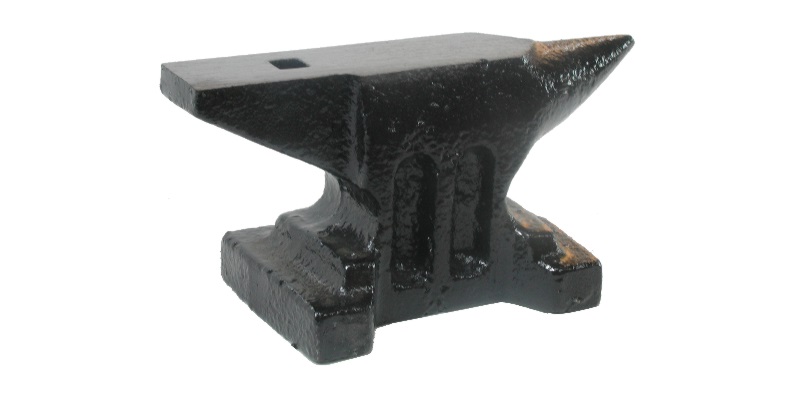

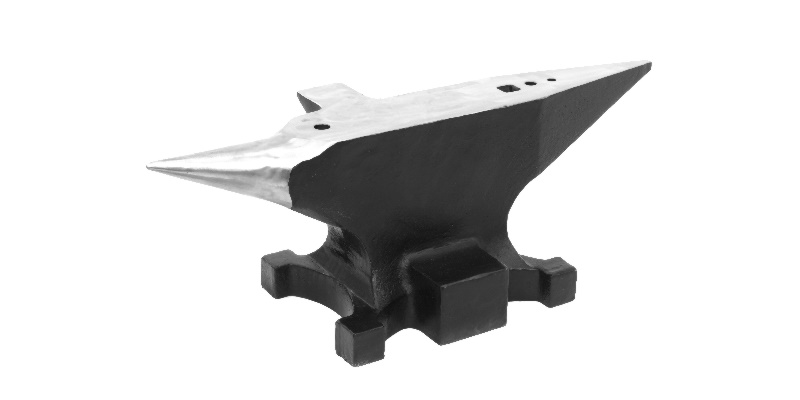

with 2 horns, with lateral fore-anvil, of cast iron, black, galvanized, surface planed, face width 20 mm, total length 170 mm, height 70 mm, weight 1,3 kg Small anvil made of gray cast iron, as a decorative object (anvil is not hardened).


with 2 horns, with lateral fore-anvil, of cast iron, black, galvanized, surface planed, face width 20 mm, total length 170 mm, height 70 mm, weight 1,3 kg Small anvil made of gray cast iron, as a decorative object (anvil is not hardened).


of alloyed cast steel, hardened, surface planed with 2 horns, with lateral fore-anvil, face width 20 mm, total length 170 mm, height 70 mm, weight ~ 1,3 kg

with 2 horns, with lateral fore-anvil, of alloyed cast steel, hardened, gold-plated, surface planed, face width 20 mm, total length 170 mm, height 70 mm, weight 1,3 kg


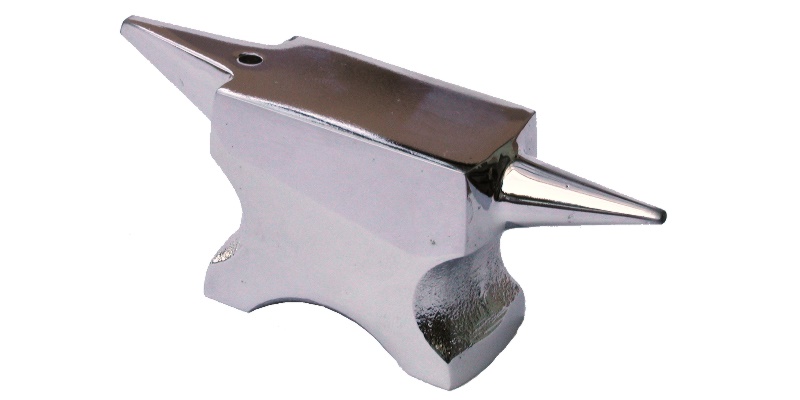
with round and square horn, of alloyed cast steel, hardened, chromium-plated, surface planed, face width 25 mm, total length 105 mm, height 40 mm, weight 450 g

with round and square horn, of alloyed cast steel, hardened, gold-plated, surface planed, face width 25 mm, total length 105 mm, height 40 mm, weight 450 g


of alloyed cast steel with round and square horn, hardened, chromium-plated, surface planed, face width 30 mm, total length 111 mm, height 44 mm, weight 490 g

with round and square horn of alloyed cast steel, hardened, surface planed and polished, face width 26 mm, total length 120 mm, height 45 mm, weight 400 g


drop forged and hardened face width 95 mm, face length 280 mm, length of horn 140 mm, total length 420 mm, height 200 mm, foot 170 x 195 mm


drop forged and hardened square hole 25 mm for anvil tools, face width 130 mm, face length 420 mm, length of horn 230 mm, total length 650 mm, height 290 mm, foot 245 x 305 mm


with lateral fore-anvil with 2 pointed horns, with upsetting foot, of alloyed cast steel, hardened, surface planed, square hole 30 mm for anvil tools, face width 130 mm, face length 450 mm, length of horns 290/290 mm, total length 1030 mm, height 385 mm, foot 440 x 330 mm


with aluminium bottom with 2 pointed horns of alloyed steel, hardened, surface planed square hole 25 mm for anvil tools face width 115 mm, face length 180 mm length of horns 150 mm, total length 500 mm height 190 mm, with aluminium foot 180 x 190 mm


with aluminium bottom with 2 pointed horns, of alloyed steel, hardened, surface planed, with little lateral foreanvil 40x35 mm, square hole 22 mm for anvil tools, face width 115 mm, face length 230 mm, length of horns 150 mm, total length 580 mm, height 215 mm, with aluminium foot 315 x 180 mm

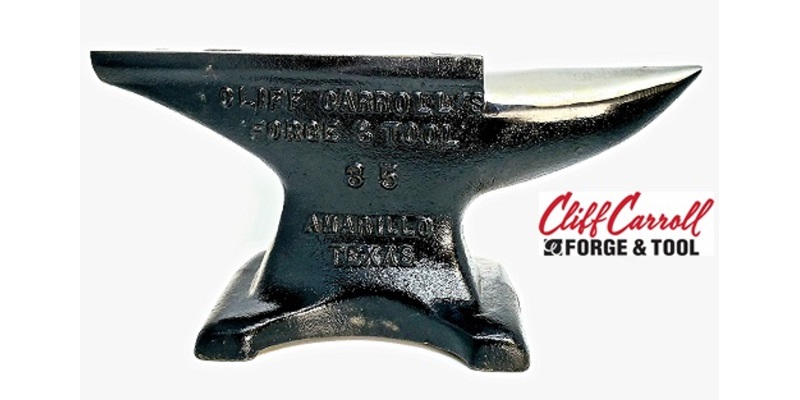
CARROLL anvil American form with 1 massive horn, made of alloyed cast steel, hardened, surface planed, face length 280 mm (11"), face width 82 mm (3,25"), horn length 215 mm (8,5"), total length 495 mm (19,5"), height 223 mm (8,75"), base approx. 27 x 22 cm (10,5"x8,5"), with 25 mm square hole for anvil tools and 13 mm round hole Cliff Carroll 70Lb Anvil Regular Face - Our most popular anvils (the regular face and the wide face) are designed to make horseshoeing faster and easier for the professional or the novice. Turning in heels or making square toes can be simple and amazingly precise using the side turning cams of these specially designed anvils. The anvil heel is tapered for shaping up those small size 00 to 000 shoes. To avoid chewing up the edges of shoes while shaping, we have rounded the anvil edges at the heel. The face is 11" long and 3 1/4" wide. The horn is 8 1/2" long.


with 2 pointed hornsa nd upsetting foot, of alloyed steel, hardened, surface planed, square hole 25 mm for anvil tools, round holes (Ø20 mm/ߠØ16 mm/Ø12 mm) face width XX mm, face length XX mm, total length XX mm, height XX mm This anvil shape is probably a mixture of a South German and Swiss anvil. Due to the upsetting and anvil, this anvil is very flexible in use and offers many advantages. The different sized holes save going to the perforated plate for many tasks. Characteristics: upsetting foot high hardness round horn various round holes square hole quality casting This form was developed by Bruce Beamish, who also personally takes care of the professional manufacture of the anvils. With the help of modern manufacturing methods, a reliable casting process and the selection of the right material, a very good quality of the anvils is ensured. All anvils are tested for hardness and subjected to a high quality check.


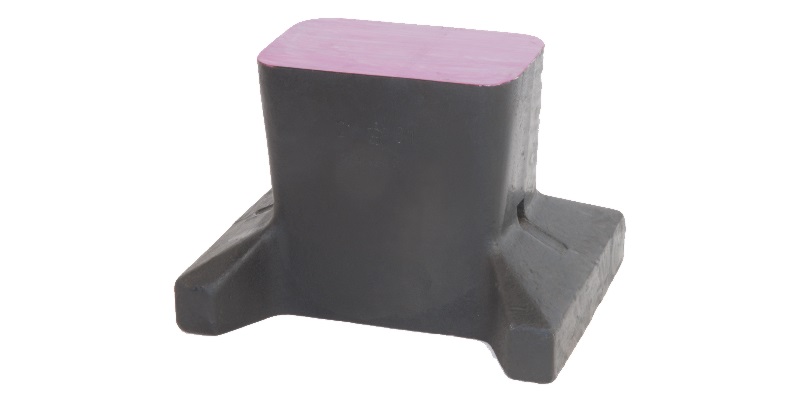
with foot plate approx. 230 kg of special alloyed steel, surface with small curvature, rectangular form, 350 x 240 mm, height 400 mm


of special alloyed steel, surface with small curvature, also available with plane surface, rectangular form, 350 x 280 mm, height 350 mm
Special - Anvil
Here you can see how a Hofi anvil is worked on. A pre-anvil, a compression horn, a round horn and a square horn are used for work. The anvil stands on a tripod and you can therefore stand close to the anvil. The height is ideally adapted for the blacksmith to enable ergonomic work.
The shape of the anvil shown is similar to the South German and Habermann anvils.
Unfortunately, both are no longer available, but our "B&W anvil" is designed based on these two originals.
You can find this
here
Questions - Answers - FAQ
Many questions about the topic of Amboss, to which we try to give answers and without meaningless AI texts.
Do you still have questions? Then please ask us directly here:
E-Mail:
How heavy does an anvil have to be?
An anvil should have the right weight for its actual use in the forge.
A knife maker, for example, does not need a heavy anvil, as there is hardly any major forming work to be done here. A wider and longer track is more advantageous here.
A farrier needs a lighter, compact anvil that can be easily transported.
A blacksmith who also carries out larger forming work on the anvil needs an anvil that is heavier so that he can also work well with aggregate.
Just ask us and we will help you make your decision.
Which anvil is right for me?
Here you should ask yourself questions in advance such as:
- how big/heavy are my workpieces?
- does the anvil have to be flexible?
- does the anvil have a fixed place?
- and much more...
We will be happy to advise you further and help you make a decision.
What can I do about a ringing anvil?
A ringing, clanking anvil is annoying.
Don't worry, you don't have to buy a new anvil.
A magnet, placed in the right place, works wonders and creates a beautiful sound.
What do I have to look out for when buying?
Here you should make sure that the anvil is reliably hardened and has good workmanship.
Unknown manufacturers and suppliers such as Temu, Aliexpress and other online sources usually sell poor quality from India or other countries. These are usually made of a cast alloy that is not suitable for anvils.
How hard should an anvil be?
An anvil should have a hardness of around 56-60 HRC on the track.
Important: Too hard is not good, as there is a risk that the edges will break or splinter.
A slightly softer anvil is often not a problem, as the hot workpiece is soft and should not be hit on the track with a hardened hammer anyway.
Where can I buy an anvil?
Of course from Angele.
We value tested quality from well-known manufacturers and test every anvil before it leaves our factory.
We know that this question is "strange", but Google wants it that way ;)
What shape should an anvil have?
Here too, there is no right or wrong. Choose the shape that suits your work.
A knife maker usually does not need different round holes or a crimp.
Buying used anvils?
Be careful when buying used anvils. There is a lot of junk on the internet and astronomical prices are being quoted for broken anvils.
When buying, pay attention to how even/flat the track is and how clean the edges are.
Also pay attention to whether there are any cracks or cavities.
Check the hardness of the track.
Ultimately, the price should be right and well below the new price of a comparable anvil.
Can I repair an anvil?
Yes, that is possible. However, there are a few things to consider here so as not to completely ruin the anvil. Only a few people know their craft and repairs are often expensive and time-consuming.
We think it's great to preserve and repair old things, but at a certain point, repairs are neither economical nor sustainable.
What is a good anvil for beginners?
Here an anvil weighing around 50 kg is sufficient.
Here you have the best price-performance ratio and the anvil is easy to move around the workshop.
Here we recommend our
drop-forged anvils
Which anvil for knife makers?
Here we recommend this anvil
Knife-forging anvil
Forged or cast?
In general, there is hardly any difference between a cast and a forged anvil.
The widespread opinion that forged anvils are better is wrong!
This may be true to a certain extent for old anvils. In the past, there were different materials, manufacturing processes and testing methods than today.
With today's manufacturing methods, casting processes and materials, both manufacturing processes are process-safe and deliver very good quality anvils.
All anvils in our range are subjected to quality testing and we have known our suppliers for years.