
Auxiliaries
...finished forging usually means it's far from completely finished:
In the technical field, the parts are still hardened and tempered with hardening powder or hardening oils. They are then preserved, burnished, painted, or oiled to protect against corrosion or achieve a specific optical effect.
We have all the tools you need...



with replaceable carbide tip The steel-scriber for professional pockets. The slim design ensures optimal handling and easy access to hard-to-reach places. Thanks to the retractable carbide tip, there is no risk of injury when storing it in a jacket or trouser pocket. The hard metal tip can be easily resharpened and should it be too badly worn, we naturally offer replacement refills. Characteristics: Carbide scriber in the shape of a ballpoint pen with replaceable carbide tip HM marking lead that can be retracted with a push button with retaining clip for jacket or trousers The company "SCALA" has been developing and producing first-class measuring tools "Made in Germany" for over 75 years.
for Steel Scriber - ball pen design


made of C75, open-die forged, hardened, one side straight, one side curved, hardened and ground, Length approx. 200mm Forged for eternity! The scriber for every bag and workshop. Filigree, free-form forged, this scriber sits perfectly in the hand. The slim design, which is curved on one side, ensures optimal handling and easy access to hard-to-reach places. Forging and hardening C75 steel makes this scriber very hard and durable and should the point ever become blunt it can be easily resharpened. Characteristics: hand-forged C75 - hard and resilient nicely balanced curly/straight side First-class quality from a small German master forge.


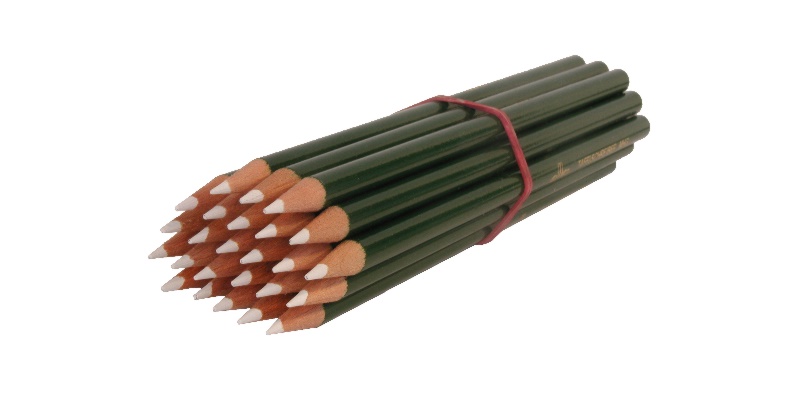
with calibrated melting point The marking melts when the precise temperature grade is reached, this change from a dry to a liquid state indicates the temperature. Tempilstik is a simple, easy-to-use temperature indicator which is guaranteed accurate to +/- 1% of the rated temperature. It is ideal for a wide range of applications from surface temperature measurement during metal working procedures such as heat treating and welding to the measurement of operating temperatures of bearings or motors. How to use: Stroke the work piece during heating. When the rated temperature has been reached a distinct melt (smear) will become evident. Tempilstik will make a mark by melting at the point of contact once the surface reaches the specific temperature of the Tempilstik.Note: The color of Tempilstik is for identification only and has no relation to its performance as a temperature indicator.Ranges are available in the Fahrenheit line from 100°F to 2,500°F and 40°C to 1,200°C in the Centigrade line.

with calibrated melting point, The marking melts when the temperature grade is reached, this change from a dry to a liquid state indicates the temperature. Set with 5 pens, delivery according to customer specification. The following temperatures [°C] are available: 79 - 204 - 316 - 400 - 482 - 650 - 680 - 760 - 774 - 816 - 843 - 871 - 900 - 1038 Please specify during ordering process, which temperatures you would like to order.


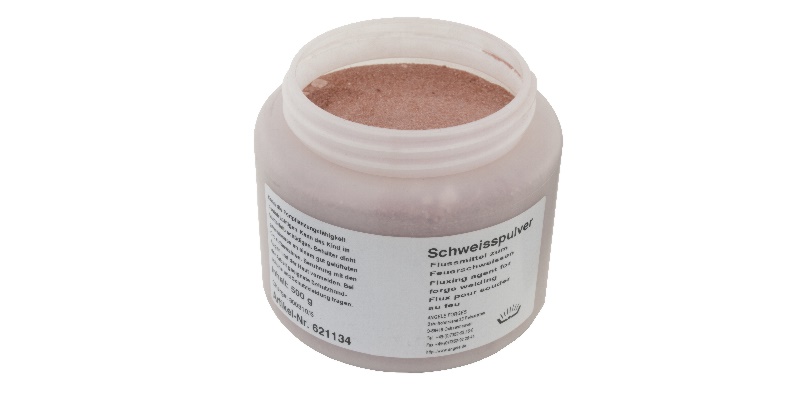
Flux for fire welding in coal, coke or gas fire, keep dry and with the lid tightly closed - anhydride compound Better than borax, the special composition makes forge welding easier and, if the workpiece is well prepared, even at lower temperatures. Instructions for use: 1. Prepare the parts to be welded (important: remove scale) 2. Heat until red and sprinkle the parts to be welded with the flux. 3. When this adheres properly, heat to yellow (less hot than for conventional forge welding). 4. When the flux appears transparent, forge lightly at first and then vigorously with quick blows. Tip: You often see that the workpieces are covered with large amounts of welding powder or borax... this is wrong and "more is better" is not the right approach, instead the welding powder should be used in a targeted manner. With a spoon lancet, the flux can be sprinkled on sparingly and precisely without burning your fingers. For commercial use only. When ordering for the first time, we reserve the right to request proof of business for inspection if necessary.
Content: 0.5 Kilogramm (€56.00 / 1 Kilogramm)

water-based, air-drying high-temperature and pressure-proof dry lubricant film, Temperature range -35°C to +600°C/-31°F to +1112°F, Features: High temperature resistance Very productive Easy punching Easy splitting Protects tools Reduces tool wear Reduces tool overheating can be mixed with water in ratio of up to 1:5 Shake/stir well before use - protect against frost Application: Simply apply Flutsch to a hole chisel or punch – this reduces friction and makes hole making significantly easier. If the tool gets too hot, the Flutsch will evaporate during application, and the graphite won't adhere optimally to the tool. In this case, allow the tool to cool briefly. Non-toxic and even approved for use in the food industry!
Content: 0.2 Liter (€0.00 / 1 Liter)


The use of hardening foil ensures that air is excluded during hardening and quenching. The hardening foil also ensures a slight delay during heating and quenching, which leads to high dimensional accuracy and less distortion of the components and leads to reproducible and safe results. Advantages: protects the workpiece from decarburization protects the workpiece during quenching ensures a safe hardening process less distortion during hardening extremely stable, thickness of 0.05 mm, can be used for all temperatures from 400 °C to 1200 °C Easy to pack easy to use suitable for complex workpiece geometries Important: This foil effectively insulates the blade from the ambient air and protects the workpiece from oxidation and decarburization. To achieve the best possible result, it is crucial to create a completely airtight seal when packing. Tip: Some knife makers put small pieces of paper in the envelope. When the paper is burned, the remaining oxygen is neutralized, which further improves the protective effect. Preparation: The hardening film can be cut to size with scissors. Please wear suitable gloves when doing this, as the film has very sharp edges. Cut the film to the appropriate workpiece size. Cover sharp edges and corners with separate pieces of film to prevent tearing. Since the oxygen expands in the packaging when heated, the air should be pressed out as best as possible. It also helps to wrap the workpiece in paper and to plug any holes in the workpiece with paper. The oxygen is then "used up" during the hardening process by the burning of the paper and no decarbonization occurs. Seal the packaging tightly with a fold, possibly pressing firmly with a roller. Place the workpiece on the charging plate in your oven. The oven should already be at hardening temperature. The film insulates so well that no thermal shock can occur. This is positive for the dimensional stability of your workpiece. For large or complicated workpieces, it is advisable to add a holding time to the hardening process. The oven should be preheated to 650°C. After a longer dwell time (adapted to the workpiece size/thickness) at 650°C, the workpiece is fully heated. You can tell that your workpiece is fully heated because the oven chamber and the workpiece are the same color. The oven can now rise to hardening temperature, which is usually selected to be around 30°C above the specified hardening temperature. The holding time at the hardening temperature is also often selected to be 10 minutes longer. After the hardening or annealing process has ended, you can quench the workpiece in the foil. Quenching in oil with the foil has the advantage that no oil gets onto the workpiece. This means that there is no discoloration. When quenching in air, this can be accelerated with a fan. Further information: The heating time may need to be extended by a few minutes to compensate for the thermal properties of the hardening foil. It may be necessary to increase the hardening temperature slightly to compensate for the insulating effect of the foil. If the workpiece is quenched together with the hardening foil, the use of a more intensive quenching medium may be necessary. This should definitely be tested on a workpiece beforehand.

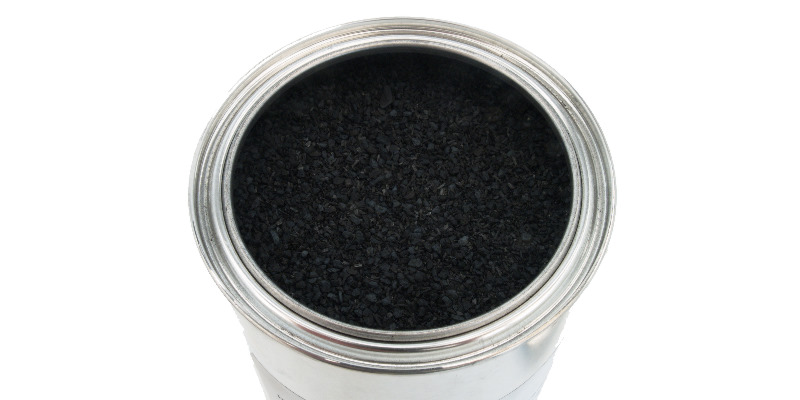
in tin can à #Varinfo Characteristics: Application temperature 600°C up to 1,100°C Glow times up to 7 hours easy to process (brushing, rolling, dipping, spraying, etc.) very productive, approx. 15µm layer thickness Drying time approx. 10-30 minutes (depending on the layer thickness, temperature) easy cleaning of the workpiece residue-free removal after heat treatment CONDURSAL Z1100 provides very good protection against scaling for tools and components that are austenitized or annealed in ovens at temperatures of 600 to 1,100°C. It is suitable for steel, stainless steel, tool steels, gray cast iron, gunmetal and for annealing times up to 7 hours and more. The paint turns black during the heat treatment and the residue from the CONDURSAL Z1100 flakes off on its own when it cools down. At higher annealing temperatures, they can then be easily removed by brushing; sandblasting is not necessary. Application: The surfaces of the workpieces to be protected must be clean, dry, free of oil, rust and grease, which can be achieved by washing or degreasing with solvents. Dedusting and removing loose components is often sufficient. Before use, CONDURSAL Z1100 must be stirred well. It is then applied using a soft flat brush or dipping method. Rolling or spraying is also possible. For full effectiveness, a layer thickness of only approx. 15µm is usually sufficient. If it is applied too thickly and, above all, unevenly, the protective layer will crack and the insulating effect will be impaired. For long glow times, two thin applications are recommended. Drying time is usually around 10 minutes per coat. Close the can tightly and airtight and clean tools such as brushes well. Removal of residues: After the heat treatment has ended, the residue from the CONDURSAL Z1100 will flake off on its own when it cools down or can be brushed off. Hints: If CONDURSAL Z1100 is applied too thickly, the protective layer will chip off. The CONDURSAL Z1100 is not suitable for annealing temperatures below 600°C. At lower temperatures it behaves like a baking varnish and then forms a black coating on the workpiece surfaces that is difficult to remove.

Zunderschutzlack Thermodur Scale X 1100 - #Varinfo in tin can à #Varinfo Features: ideal for knife blades ensures even heating/cooling Application temperature 600 to 1,100°C quick processing (spray) very economical, approx. 10-15µm layer thickness Drying time approx. 2 minutes (at 40°C) residue-free removal after heat treatment Operation: Thermodur Scale X 1100 avoids the formation of scale during the heat treatment of steel, stainless steel and tool steel. This ensures uniform heating and cooling and reduces the risk of edge decarburization (carbon loss) on the surface of the workpiece. Particularly ideal for knives and blades that have already been ground to size and where uniform heating is required during the hardening process. The lacquer also ensures uniform cooling during quenching and thereby reduces hardness errors in the workpiece or blade. Application: 1. Cleaning the workpiece (grease-free, dust-free, dry, metallically clean) 2. Shake the spray can 3. Apply evenly to the workpiece (very thin layer) 4. If the curing process is longer, apply another layer (let the previous layer dry for at least 10 minutes) 5. Allow the workpiece to dry completely before placing it in the oven (approx. 30 minutes at room temperature) 6. Heat treat the workpiece in the oven 7. Quench the workpiece - this causes the paint to “fall off”. If any residue is still visible, carefully remove it with a fine wire brush. Notice: It is better to apply the varnish thinly in 2 passes and let it dry thoroughly. When spraying, work under an exhaust system, outdoors or in very well-ventilated rooms.

Black finishing (Ballistol®) guarantees permanent and wear-resistant browning Please note that this black finishing does not work on steel containing more than 3% Chromium. Proceed like this: the workpiece has to be degreased carefully (e.g. with our Cold Degreaser). Then apply black finishing by means of a dropper or brush on the parts to be browned. Allow to react for say 3 minutes until a yellow-whitish cover forms. Then wash it off with water, dry it by dabbing with a soft cloth and spray BALLISTOL on it. Ready!</i>

guarantees permanent and wear-resistant browning Please note that this black finishing does not work on steel containing more than 3% Chromium. Coverage (rough guideline): 10m²/l Proceed like this: the workpiece has to be degreased carefully (e.g. with our Cold Degreaser). Then apply black finishing by means of a dropper or brush on the parts to be browned. Allow to react for say 3 minutes until a yellow-whitish cover forms. Then wash it off with water, dry it by dabbing with a soft cloth and spray BALLISTOL on it. Ready!

fluid for degreasing, aerosol Oil and grease are removed from metallic surfaces, even persistent remainders of grease and resin will disappear without any problems. Ideal as a preliminary treatment to the browning process with our black finishing. Application: Depending on the degree of oiliness, spray several times onto the part to be degreased and then wipe off. Finally, spray the grease-free area again. After drying, the area is free of grease, and the subsequent treatment can now be carried out.
Content: 0.05 Liter (€0.00 / 1 Liter)

guarantees permanent and wear-resistant browning Set consists of - Cold Degreaser spray 50 ml - Quickbrowning 50 ml - Ballistol spray 50 ml - 2 pair nitrilic gloves - 2 brushes - 2 lintless clothes Please note that this black finishing does not work on steel containing more than 3% Chromium. Proceed like this: the workpiece has to be degreased carefully (e.g. with our Cold Degreaser). Then apply black finishing by means of a dropper or brush on the parts to be browned. Allow to react for say 3 minutes until a yellow-whitish cover forms. Then wash it off with water, dry it by dabbing with a soft cloth and spray BALLISTOL on it. Ready!

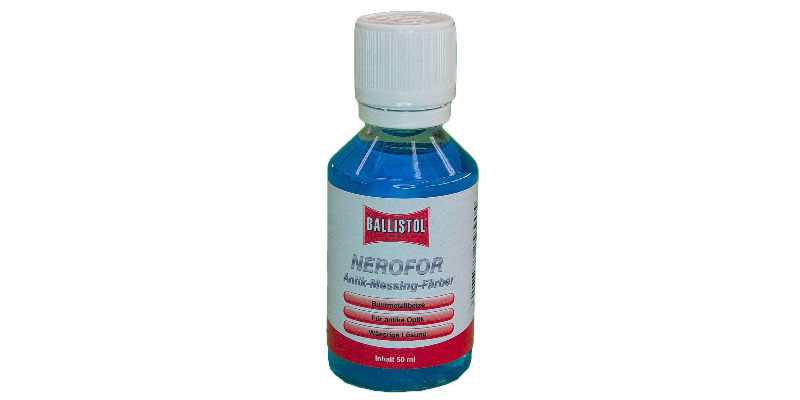
guarantees permanent and wear-resistant browning Copper, brass, and bronze acquire a black surface through this treatment; this process is also known as blackening. Silver also acquires a black surface through this treatment. Depending on the exposure time, the intensity of the color can be varied from brown to dark brown to black. This is particularly useful when creating an elegant, antique-looking finish. Ideal for creating an "antique" look for all non-ferrous metals Color depth can be individually determined by the exposure time PTFE- and silicone-free Application: 1. Pretreatment The parts to be colored must be thoroughly degreased and free of any oxidation. First, pretreat with fine steel wool or sandpaper (maximum 380 grit). Then degrease the workpiece (we recommend Ballistol Cold Degreaser) or treat it with 30% hydrochloric acid. Finally, rinse thoroughly with warm water. 2. Application Application depends on the size of the area to be treated: apply with a brush, spray, or by immersion. The ideal immersion temperature is approximately 30–35 °C. A lower temperature slows down the process and thus extends the reaction time. Caution: The immersion temperature must not exceed 40 °C. The immersion time is approximately 1 to 3 minutes. Depending on the desired tint, the workpiece should be immersed for a shorter or longer time. 3. Aftercare First, rinse the workpiece with fresh water after application. Then, wipe off any water with a dry cloth or rag and apply a clear varnish, wax, or oil for a clean finish. Want to achieve a lighter shade? Color variations by dilution up to 1:4 The bluing agent can be diluted with water up to a mixing ratio of 1:4. The more water, the browner the color. The less water, the darker the color. Applying pure results in a black coloration on most non-ferrous metals.
Content: 0.05 Liter (€0.00 / 1 Liter)


guarantees permanent and wear-resistant browning This product allows you to easily apply a patina to copper, bronze, and brass. It creates a beautiful antique look, giving the metal an artificially aged appearance. To make it easier to use, this non-ferrous metal coloring agent has been formulated as a gel. This significantly simplifies application on the workpiece, making it easier to treat even larger items. However, the gel can also be used for immersion if desired. The resulting shade depends on the dilution ratio and the contact time. Copper, bronze, and brass surfaces can be colored to a dark brown or anthracite tone. Diluting with water allows for a lighter antique finish; the product can be diluted up to 1:5 with water, though a maximum dilution of 1:3 is recommended for brushing. Alternatively, the object can be dipped directly into the undiluted solution. Our patina gel is also suitable for nickel silver, but it is not suitable for silver, aluminum, chrome, nickel, or stainless steel. (contains zinc sulfate, copper sulfate pentahydrate, phosphoric acid, selenium dioxide)
Content: 0.05 Liter (€0.00 / 1 Liter)

guarantees permanent and wear-resistant browning Application: before application metals must be degreased. For application use a brush, smaller metal parts may also be dipped. After about 30 seconds exposure time the metal can be rinsed off with water. Afterwards dry the workpiece with a soft cotton cloth. To get a matte sheen you can spray the workpiece with Ballistol universal oil. The bluing is very productive. About 100 ml is needed for one square meter.
Content: 0.05 Liter (€0.00 / 1 Liter)


100% natural ingredients, for caring and preserving blades, wood, leather and much more, can with 60g content Properties: 100% natural ingredients handmade food safe easy to process easy to use suitable for wood, leather, metal, plastic preserves, protects, cares What is it used for? For the care and preservation of blades, handle materials, cutting boards, and much more. It prevents rust, keeps leather supple, protects wood and other materials and can be used for almost EVERYTHING. How is it used? 1. Clean part 2. Apply with a clean, dry cloth and work in evenly 3. Remove excess wax with a cloth 4. Repeat process if necessary
Content: 0.06 Kilogramm (€333.33 / 1 Kilogramm)


proofed and tested, special blend of 100% natural oils such as linseed and rapeseed oil. For “blackening” or preserving steel, wood, and much more. What is Blacksmith Oil? Our forge oil is a tried and tested, Special blend of 100% natural oils such as linseed and rapeseed oil. It can for “blackening” or preserving steel, wood, and much more. be used. Black coloring: When blackening, the workpiece is warmed slightly and then covered with a thin layer of oil. This is then held over a soot-free fire and slowly heated. This causes stuck-on carbon to decompose on the surface. First a brown, then a black, sticky color is created. This process can be repeated until the desired depth of coloring is achieved. This method protects the workpiece from corrosion. Suitable for all metals, copper, brass, bronze, and much more. Notice: The OIL can be applied with a brush or cloth. Shake the bottle well before use and close it properly after use. Photo 4 shows a grill fork blackened or burned black with blacksmith oil. The staining was created in 2 passes.


Ballistol® Universalöl Note: The mixture is classified as non-hazardous within the meaning of Regulation (EC) No. 1272/2008 [CLP].
Content: 0.05 Liter (€0.00 / 1 Liter)


Ballistol® 50 ml Spray Universal oil – uniquely versatile and environmentally friendly: - Cares for, lubricates, disinfects, protects against rust - Penetrates into the smallest corners, provides excellent lubrication, does not resinify, and is completely biodegradable. - Food-safe, skin-friendly, and completely harmless BALLISTOL® Universal Oil is free of silicone, PTFE, acids, and resins, and does not resinify.
Content: 0.05 Liter (€73.00 / 1 Liter)