
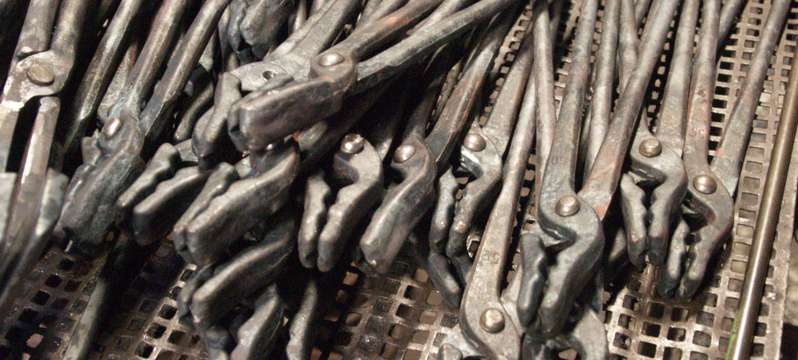
Forging
"Life is too short to work with bad tools"
With us you will find everything for your craft and hobby.
We develop and produce some products such as coal and gas forge fires here in Ochsenhausen - Germany.
We source tried and tested machines, high-quality tools and a whole range of other stuff such as paints, oils and tool steels from well-known manufacturers, blacksmithing experts and smaller manufacturers.


with waist protection cracked leather w x h approx. 80 x 100 cm


made of 70% Polyacryl, 30% Aramid with high-vacuum metallisation, with neck strap and tie straps for closing, length approx. 130 cm, width approx 98 cm EN ISO 11612:2015, Standard A1/B1/C3/D3/E3/F1 Professional quality for use in foundries, steel and aluminum works, offering the best possible protection against Iron and Aluminium liquid splashes according to EN 11612 (D3, E3) as well as very good protection against radiant heat (C3).


made of 100 % para-aramide with high-vacuum metallisation, with neck strap and tie straps for closing, length approx. 130 cm, width approx 98 cm EN ISO 11612, Standard A1/B1/C3/D3/E3/F1 Robust protection for demanding users: enhanced heat protection through aluminization of the Kevlar®/para-aramid fabric; highly durable and heavy-duty.


solid but soft leather Leather is a natural product. We must therefore reserve the right to color deviations and color changes. Please note the size information in the Downloads tab!


solid but soft leather width ~ 60 cm, total length of hip belt ~ 140 cm, height of the apron ~ 74 cm, with 2 exterior pockets and an inside pocket Leather is a natural product. Color and hue are subject to change.


with your own motif or text Customized product - No cancellation, exchange or return! To engrave your logo we need: The logo (by email) The desired logo size (mm) The position (standard is at chest height) Important information: A reasonable logo size is approx. 30x30 - 80x80 mm. Send us your logo by e-mail to info@angele.de. After checking your file, we will send you an order confirmation. Please avoid shading, grids or color gradients in the template and ensure that the image resolution is adequate. Readable pixel file formats: * .tif, * .bmp, * .jpg, * .gif, * .pcx, * .pdf Readable vector data formats: * .ai, * .eps, * .dxf, * .dwg, * .wmf, * .plt, * .cdr, * .pdf Only applies in conjunction with the purchase of one of our leather aprons.

special rubber, heat protection up to 200°C contact heat, cutt protection, grey, Size 10, approx. 34 cm total length The soft protective felt offers heat protection up to approx. 200°C contact heat, at the same time effective protection against cuts, abrasion and burrs.

Extra lightweight goggles, made of impact-resistant plastic, adjustable temples for length and angle, scratch-resistant viewing glass, rubberized nose bridge, and high wearing comfort, according to EN166CE Features: Compliant with DIN EN 166:2001 / DIN EN 170:2002 Scratch-resistant coating Clear vision Anti-fog Shape-stable yet flexible Comfortable soft components in the nose area Highly comfortable temples Optimal fit Lightweight


Please note: Two images show the glasses with a clip attached, this clip is available as an accessory (# 618256) and is not included.


shatter-proof polycarbonate lenses, wide flexible textile strap ensures a firm fit, for a very wide range of applications: Liquids / Dust / Molten metal


Ideal for FIRE WELDING! Effective protection for the eyes from UV and IR rays and from glare (protection level WE3). Note: Inadequate protection against laser radiation! One illustration shows the glasses with the clip attached. The glasses are available individually and are not part of the delivery scope of the displayed item 618256.

without collar, long arm, buttons on half the length, with front pocket, twisted yarn, 100 % cotton, hard wearing, washable at 60°C Original work fabric for blacksmiths and metalworkers. This fabric is particularly durable. The use of double-threaded yarn combined with an extremely dense weaving technique provides perfect protection against heat and sparks, while remaining comfortable to wear even during physical labor. The blacksmith shirts can be washed at up to 60°C. Soak the garment in cold water for 12 hours before the first wash to ensure the fabric does not shrink by more than 2%. The colors are colorfast and will not bleed. Make sure the detergent does not contain bleach. Do not tumble dry. Please note that the shirts run relatively large – usually one size smaller than the "regular" size fits (see also the next tab, Downloads). Produced from materials tested for harmful substances · Manufactured in environmentally friendly facilities using resources efficiently · Manufactured in socially acceptable, safe workplaces · Meets both STANDARD 100 by OEKO-TEX® and STeP by OEKO-TEX® bluesign® APPROVED · Sustainable treatment of people and the environment through safe processes and components throughout the entire production chain Please note that the shirts are relatively large - you can find more information about sizes in the next tab (Downloads).


without collar, short sleeve, with front pocket, twisted yarn, 100 % cotton, hard wearing, washable at 60°C Please note that the shirts are relatively large - you can find more information about sizes in the next tab (Downloads).


without collar, long arm, buttons on half the length, twisted yarn, 100 % cotton, hard wearing, washable at 60°C


Flux for fire welding in coal, coke or gas fire, keep dry and with the lid tightly closed - anhydride compound Better than borax, the special composition makes forge welding easier and, if the workpiece is well prepared, even at lower temperatures. Instructions for use: 1. Prepare the parts to be welded (important: remove scale) 2. Heat until red and sprinkle the parts to be welded with the flux. 3. When this adheres properly, heat to yellow (less hot than for conventional forge welding). 4. When the flux appears transparent, forge lightly at first and then vigorously with quick blows. Tip: You often see that the workpieces are covered with large amounts of welding powder or borax... this is wrong and "more is better" is not the right approach, instead the welding powder should be used in a targeted manner. With a spoon lancet, the flux can be sprinkled on sparingly and precisely without burning your fingers. For commercial use only. When ordering for the first time, we reserve the right to request proof of business for inspection if necessary.
Content: 0.5 Kilogramm (€56.00 / 1 Kilogramm)

water-based, air-drying high-temperature and pressure-proof dry lubricant film, Temperature range -35°C to +600°C/-31°F to +1112°F, Features: High temperature resistance Very productive Easy punching Easy splitting Protects tools Reduces tool wear Reduces tool overheating can be mixed with water in ratio of up to 1:5 Shake/stir well before use - protect against frost Application: Simply apply Flutsch to a hole chisel or punch – this reduces friction and makes hole making significantly easier. If the tool gets too hot, the Flutsch will evaporate during application, and the graphite won't adhere optimally to the tool. In this case, allow the tool to cool briefly. Non-toxic and even approved for use in the food industry!
Content: 0.2 Liter (€0.00 / 1 Liter)


The use of hardening foil ensures that air is excluded during hardening and quenching. The hardening foil also ensures a slight delay during heating and quenching, which leads to high dimensional accuracy and less distortion of the components and leads to reproducible and safe results. Advantages: protects the workpiece from decarburization protects the workpiece during quenching ensures a safe hardening process less distortion during hardening extremely stable, thickness of 0.05 mm, can be used for all temperatures from 400 °C to 1200 °C Easy to pack easy to use suitable for complex workpiece geometries Important: This foil effectively insulates the blade from the ambient air and protects the workpiece from oxidation and decarburization. To achieve the best possible result, it is crucial to create a completely airtight seal when packing. Tip: Some knife makers put small pieces of paper in the envelope. When the paper is burned, the remaining oxygen is neutralized, which further improves the protective effect. Preparation: The hardening film can be cut to size with scissors. Please wear suitable gloves when doing this, as the film has very sharp edges. Cut the film to the appropriate workpiece size. Cover sharp edges and corners with separate pieces of film to prevent tearing. Since the oxygen expands in the packaging when heated, the air should be pressed out as best as possible. It also helps to wrap the workpiece in paper and to plug any holes in the workpiece with paper. The oxygen is then "used up" during the hardening process by the burning of the paper and no decarbonization occurs. Seal the packaging tightly with a fold, possibly pressing firmly with a roller. Place the workpiece on the charging plate in your oven. The oven should already be at hardening temperature. The film insulates so well that no thermal shock can occur. This is positive for the dimensional stability of your workpiece. For large or complicated workpieces, it is advisable to add a holding time to the hardening process. The oven should be preheated to 650°C. After a longer dwell time (adapted to the workpiece size/thickness) at 650°C, the workpiece is fully heated. You can tell that your workpiece is fully heated because the oven chamber and the workpiece are the same color. The oven can now rise to hardening temperature, which is usually selected to be around 30°C above the specified hardening temperature. The holding time at the hardening temperature is also often selected to be 10 minutes longer. After the hardening or annealing process has ended, you can quench the workpiece in the foil. Quenching in oil with the foil has the advantage that no oil gets onto the workpiece. This means that there is no discoloration. When quenching in air, this can be accelerated with a fan. Further information: The heating time may need to be extended by a few minutes to compensate for the thermal properties of the hardening foil. It may be necessary to increase the hardening temperature slightly to compensate for the insulating effect of the foil. If the workpiece is quenched together with the hardening foil, the use of a more intensive quenching medium may be necessary. This should definitely be tested on a workpiece beforehand.

in tin can à #Varinfo Characteristics: Application temperature 600°C up to 1,100°C Glow times up to 7 hours easy to process (brushing, rolling, dipping, spraying, etc.) very productive, approx. 15µm layer thickness Drying time approx. 10-30 minutes (depending on the layer thickness, temperature) easy cleaning of the workpiece residue-free removal after heat treatment CONDURSAL Z1100 provides very good protection against scaling for tools and components that are austenitized or annealed in ovens at temperatures of 600 to 1,100°C. It is suitable for steel, stainless steel, tool steels, gray cast iron, gunmetal and for annealing times up to 7 hours and more. The paint turns black during the heat treatment and the residue from the CONDURSAL Z1100 flakes off on its own when it cools down. At higher annealing temperatures, they can then be easily removed by brushing; sandblasting is not necessary. Application: The surfaces of the workpieces to be protected must be clean, dry, free of oil, rust and grease, which can be achieved by washing or degreasing with solvents. Dedusting and removing loose components is often sufficient. Before use, CONDURSAL Z1100 must be stirred well. It is then applied using a soft flat brush or dipping method. Rolling or spraying is also possible. For full effectiveness, a layer thickness of only approx. 15µm is usually sufficient. If it is applied too thickly and, above all, unevenly, the protective layer will crack and the insulating effect will be impaired. For long glow times, two thin applications are recommended. Drying time is usually around 10 minutes per coat. Close the can tightly and airtight and clean tools such as brushes well. Removal of residues: After the heat treatment has ended, the residue from the CONDURSAL Z1100 will flake off on its own when it cools down or can be brushed off. Hints: If CONDURSAL Z1100 is applied too thickly, the protective layer will chip off. The CONDURSAL Z1100 is not suitable for annealing temperatures below 600°C. At lower temperatures it behaves like a baking varnish and then forms a black coating on the workpiece surfaces that is difficult to remove.

Zunderschutzlack Thermodur Scale X 1100 - #Varinfo in tin can à #Varinfo Features: ideal for knife blades ensures even heating/cooling Application temperature 600 to 1,100°C quick processing (spray) very economical, approx. 10-15µm layer thickness Drying time approx. 2 minutes (at 40°C) residue-free removal after heat treatment Operation: Thermodur Scale X 1100 avoids the formation of scale during the heat treatment of steel, stainless steel and tool steel. This ensures uniform heating and cooling and reduces the risk of edge decarburization (carbon loss) on the surface of the workpiece. Particularly ideal for knives and blades that have already been ground to size and where uniform heating is required during the hardening process. The lacquer also ensures uniform cooling during quenching and thereby reduces hardness errors in the workpiece or blade. Application: 1. Cleaning the workpiece (grease-free, dust-free, dry, metallically clean) 2. Shake the spray can 3. Apply evenly to the workpiece (very thin layer) 4. If the curing process is longer, apply another layer (let the previous layer dry for at least 10 minutes) 5. Allow the workpiece to dry completely before placing it in the oven (approx. 30 minutes at room temperature) 6. Heat treat the workpiece in the oven 7. Quench the workpiece - this causes the paint to “fall off”. If any residue is still visible, carefully remove it with a fine wire brush. Notice: It is better to apply the varnish thinly in 2 passes and let it dry thoroughly. When spraying, work under an exhaust system, outdoors or in very well-ventilated rooms.

Black finishing (Ballistol®) guarantees permanent and wear-resistant browning Please note that this black finishing does not work on steel containing more than 3% Chromium. Proceed like this: the workpiece has to be degreased carefully (e.g. with our Cold Degreaser). Then apply black finishing by means of a dropper or brush on the parts to be browned. Allow to react for say 3 minutes until a yellow-whitish cover forms. Then wash it off with water, dry it by dabbing with a soft cloth and spray BALLISTOL on it. Ready!</i>

guarantees permanent and wear-resistant browning Please note that this black finishing does not work on steel containing more than 3% Chromium. Coverage (rough guideline): 10m²/l Proceed like this: the workpiece has to be degreased carefully (e.g. with our Cold Degreaser). Then apply black finishing by means of a dropper or brush on the parts to be browned. Allow to react for say 3 minutes until a yellow-whitish cover forms. Then wash it off with water, dry it by dabbing with a soft cloth and spray BALLISTOL on it. Ready!

fluid for degreasing, aerosol Oil and grease are removed from metallic surfaces, even persistent remainders of grease and resin will disappear without any problems. Ideal as a preliminary treatment to the browning process with our black finishing. Application: Depending on the degree of oiliness, spray several times onto the part to be degreased and then wipe off. Finally, spray the grease-free area again. After drying, the area is free of grease, and the subsequent treatment can now be carried out.
Content: 0.05 Liter (€0.00 / 1 Liter)