
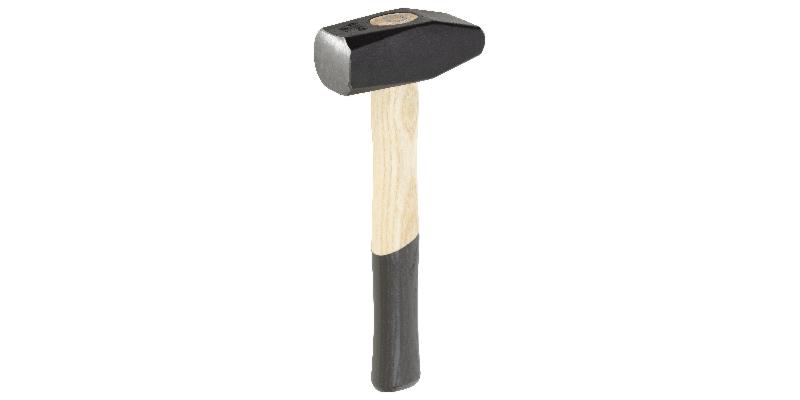
Forging tools
Good tools alone are no guarantee of good work, but they are much more fun to work with because:
Life is too short to work with bad tools!
Like all blacksmithing tools, our tools are extremely robust and will last for generations if used correctly. But here too, care should not be neglected in order to enjoy them for one or more lifetimes.


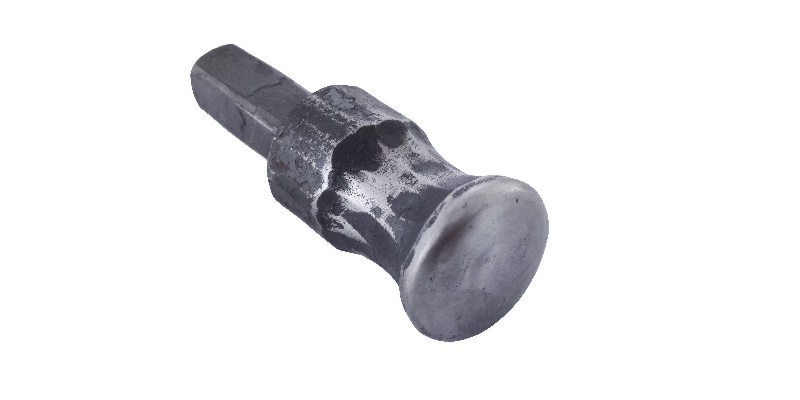
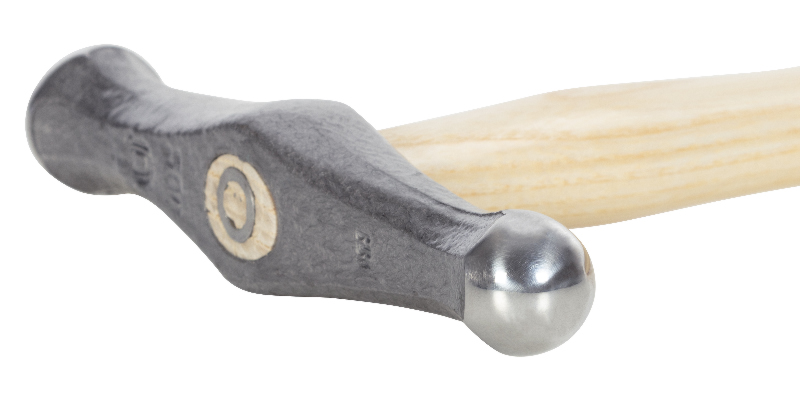


for own forging material C 45, for tempering in water

Raw piece for hammers 1,5 kg for own forging material C 45, for tempering in water


for forging yourself approx. 50x30x160 mm Characteristics: Head size approx. 50x30x160 mm approx. 2,0 kg head weight Material C45 (forged) easy to forge and harden approx. 600 mm long handle This ax blank is specially produced for us in Germany. The eye has already been inserted and corresponds to the valid DIN standard. This means that standard handles for axes and hatchets fit. The long handle allows for a secure grip when forging and machining. After it has been individually shaped, it can simply be separated. We chose C45 as the material because it is easy to machine and forgives one or two mistakes. C45 can also be hardened well in water or oil.

for own forging shank 25 mm material C 45, for tempering in water

octagon, Chrome-Vanadium, DIN 6434 Set of 7 pieces, consisting of rivetting setter 2,3,4,5,6,8,10 mm The rivet head makers in a set, in a practical plastic box made from 100% recycled plastic. Octagonal shaft Burned-enamel finish Chrome-vanadium air-hardening steel Selectively hardened Hammer head tempered Curving, beading, and chipping are virtually eliminated thanks to the selective hardening process The classic - MADE in Germany!


consisting of: scythe hammer, scythe anvil and scythestone and book "Dengeln & Wetzen" With this set, you're perfectly equipped to sharpen and hammer your scythe. Instead of the combined individual prices of € 76,90 the set is only € 60,65 (german VAT applied).


0,5 kg with ash handle A workshop on how to properly sharpen a scythe can be found at: https://scythesupply.com/peeningworkshop.html


0,5 kg, with ash handle A workshop on how to properly sharpen a scythe can be found at: https://scythesupply.com/peeningworkshop.html


scythe hammer one peen, fine polished 0,5 kg with ash handle A workshop on how to properly sharpen a scythe can be found at: https://scythesupply.com/peeningworkshop.html


260x36x15 mm, Original SILICAR, grit size 220 More information and a workshop you can also find at https://scythesupply.com/peening-and-sharpening-european-scythe-blades.html

short A workshop on how to properly sharpen a scythe can be found at: https://scythesupply.com/peeningworkshop.html

short When peening with this anvil, the scythe is placed upside down (unlike when mowing) and struck with the flat face of the peening hammer. A workshop (in English) on how to properly peen a scythe can be found at: https://scythesupply.com/peeningworkshop.html


long spike, 1 kg total length about 320 mm, face dimension 50x50 mm A workshop on how to properly sharpen a scythe can be found at: https://scythesupply.com/peeningworkshop.html


long spike, 1 kg total length ~ 470 mm When peening with this anvil, the scythe is placed upside down (unlike when mowing) and struck with the flat face of the peening hammer. A workshop (in English) on how to properly peen a scythe can be found at: https://scythesupply.com/peeningworkshop.html


with Hickory handle Used to level saws. Forged head, made of high carbon C45E steel, with induction heat treatment of the working surfaces (approx. 54 HRC). Working surfaces domed and finely polished.

chrome-molybdenum air-hardening steel, DIN 6453, Width of blade approx. #varinfo This chisel is primarily suitable for cold working.


manganese silicon steel length 240 mm, width 26 mm, thickness 7 mm, blade 3 mm


made of aluminium, approx. 160 x 80 x 8 mm It stands to reason that when two forces come together one or the other will show the result of the immpact.... When these marks of the impact are left in the anvil, it is annoying. Sharp, hard and pointed tools can leave marks on the anvil. For this reason, the protective pad is used when splitting, punching, and much more - shortly before piercing the workpiece - between the anvil and the workpiece to protect the path of the anvil. This pad is easier and cheaper to replace than the whole anvil...